My name is Nick, I am a Wisconsin dad who loves all things fitness, diving, and food! Persistent Resilience is a log of the fun and craziness that is my life. I am passionate about running, I love to see how far I can push myself, and my favorite runs are off-road. Currently I am trying to add to my ultra-marathon experience. If you have any questions about how/why I run or eat the way that I do please do not hesitate to contact me by leaving a comment, via facebook, or by email at nmwied@hotmail.com. Thanks for Visiting


24 May 2013

“You Run To Find Quiet” –2013 Ice Age Trail 50 Mile Race Report

“You Run To Find Quiet” – Ice Age Trail 50 Mile Race Report

“Daddy I know why you run for so long in the woods!”  This was how my daughter started a facetime conversation with me while I was in NJ, the morning before the race.  I asked her why and she responded; “When you run in nature your heart is talking to God.”  I was shocked, as I usually am, by the crystal clarity my daughter’s statements can provide during hectic times.  The days leading up to the Ice Age Trail 50 Mile race had been truly hectic.  I believe that racing ultra-distance events prepares you for the challenges of life, and I was about to fully test this theory.
It started three weeks earlier when I raced the Mad City 50K.  I had a great race but had really punished my legs.  I have never raced 2 ultras so close together before so I was entering uncharted territory.  Then a week before the race my boss called to ask if I was busy the following week, race week.  I told him my birthday was on Wednesday and Saturday I was racing 50 miles.  His response was, “good you are free Thursday and Friday, we need you in NJ.”  Finally the winter in WI had been exceptionally brutal and had not really dissipated until the prior 2 weeks.  This meant that I had zero race specific training for a hilly, trail, 50 mile race.  As I was flying home Friday evening the guy next to me asked if I had plans for the weekend, after telling of the race he commented that I seemed really relaxed for someone about to run 50 miles. I was, deep down I needed this race, the trails, the challenge, and the quiet of nature so my heart could talk to God!  Well, let the challenge begin, it was time to find my quiet.
Racing the Mad City 50K had left my legs tired, but I was pretty sure they had recovered enough to finish and possibly race the 50 miles.  Keeping this in mind I lined up in the middle of the crowd, and decided to take the first 9 mile loop extremely easy.  I say crowd because there were over 400 starters for the 50 Mile race.  Due to my starting position as well as the slower beginning pace (11-12 min miles) I got to run with some incredible individuals.  One such gentleman was Mike Price from Salt Lake City, UT.  Mike is 62, started running ultras in the early 80’s, and has run almost all of them (over 200).  Clicking off early miles with him involved an awesome game of name that race.  I named them, he told me how many times he finished, DNF’d, or DNS’d, and how to train for them.  This was awesome and the early 9 mile loop flew by.  As I came into the aid station (mile 9) I decided my legs felt good so I would gradually pick up the pace.  I made the decision here that I would not be passed by ANYONE in this race, I would only pass people.   I normally run ultras on water and gels, well I surveyed the aid table and there were no gels.  The volunteer apologized, I smiled, thanked them for everything, and told them; “No worries, you guys are awesome, time to run my first ultra on ginger ale.”
The next 14 or so miles down to Rice Lake (mile22) went pretty smoothly.  I took the technical sections closer to the lake pretty easy, especially the climbing.  I had mentally prepared for this eventuality as I had zero specific trail hill training for this race due to the disaster that was the WI winter.  I power hiked most of the hills, where I ran them last year.  (A great article regarding specific race training and it effects is Zach Bitter’s (3rd place).)  A holdover benefit I received from my speed training for Mad City, similar to Zach’s, was my enhanced ability to descend the technical trails.  My descending, normally strength, was enhanced by the speed work which increased my foot turn over allowing me to “fall” down the hill more efficiently.  I had slowly picked up the pace, and by the turn at mile 22 was running pretty quick.  I was really feeling connected with the trail and my surroundings and was about to have even more time to acquaint with them.
I had been waiting for some deep hidden fatigue in my legs to slow me.  It was a driving rain/hail storm that got to me first.  Luckily I had kept my arm sleeves on and rolled them back up, right on hypothermia averted!  Then right after leaving the mile 26 aid some deep fatigue in my left quad, a hold-over from Mad City made itself known.  While descending a small hill I felt a small hot bomb explode inside my quad, ending my ability to descend quickly.  What I found truly amazing was that when this happened instead of causing my mood to sour, I suddenly began to enjoy the trail even more.  I ran mostly alone, other than passing people, till the next turn at mile 40.  During this time I reflected on just how lucky I am to be able to run in such a beautiful environment, and how truly blessed I am to have the ability to enjoy it in a manner that, as my daughter told me, allowed my heart to talk to God!  I was finding my quiet.  I was keeping good on my plan to only pass people and not be passed.  Filling my bottles shirtless, in 50 degree temps, and with 10 miles to run I had huge grin on my face that really fired up some of the volunteers.  I was suddenly ready to run hard.  I left and let my body float down the trail.
The final 10 miles to the finish were some of the most exhilarating miles I have ever run.  My quad had either gone numb due to effort, or my mind had shut the pain out, and suddenly my ability to descend returned.  I took full advantage of this and my euphoric mood to push the pace to the finish.  I ran truly feeling the trail, becoming one with my environment.  I ran hard.  I ran fast.  I danced down the descents like a child running to a playground.  I ran because I needed to, I had found my quiet on the trail.  I cannot really explain why I felt so at peace 7+ hours into a run, but 50 miles suddenly didn’t seem long enough.  During some of the flatter sections I glanced down at my watch to see that I was holding 7 min pace, and on a few of the descents had dipped into the 5 min range.  This fast running allowed me to finish the race in 53rd place.  I was never passed the entire race!
I crossed the finish smiling.  I was truly happy; not to be done, not because I had achieved some great race result or time, Just Happy!  I had found my quiet, my heart truly had its chance speak with God, and my body had a chance to be rejuvenated by nature.  I am truly thankful to Jeff Mallach, the RD, and his exceptional crew of volunteers form making the 2013 a great race, and great experience.  Thank you also to my family who supports my desire to push my body and discover just how far I can go!  Thank you also to my sponsors; Performance Running Outfitters and VESPA, your gear, support, and advice make racing and self discovery so much fun! As a side note now that my mind thinks 50 mile/ 6-8 hour runs are business as usual, it may be time to increase distance and stretch to a new challenge!
Finding my quiet, heart talking to God! Photo by Ali Engin
Race Gear & Nutrition
Nutrition
Pre-Race
1 VESPA Concentrate
1 multi vitamin, fish oil, vit D
4 Capra Flex
3 Justin's Chocolate Hazelnut Butter packets
1 Green Tea w 1 TBSP of coconut oil
1 VESPA JR
Race
48oz coconut water
1 VESPA Concentrate
VESPA JR's
3 Gels
Ginger Ale
Coke (Final 10 Miles)
7 S-Cap salt tabs
Post Race
Guinness and good food!!!!
8 Capra Flex
1 multi-vitamin & fish oil
Gear
The North Face - Better than Naked shorts, & arm sleeves - Performance Running Outfitters (PRO)
Hoka One One Bondi 2B - iRunFar.com 
Ultimate Direction - uno waist pack (1st 25 miles) & hand held (final 25 miles) - PRO
Drymax - Trail runner socks - PRO
Salmon S-Lab Hydro Set (2 8oz flasks) - PRO

20 May 2013

Hand Held Hydration Evolved - 2013 Salomon Sense S Lab Hydro Set Gear Review

Hand Held Hydration Evolved - 2013 Salomon Sense S Lab Hydro Set Gear Review


What comes in box 2 gloves & 1 8oz flask
 I was recently given a new Salomon Sense S Lab Hydro Set to demo by Performance Running Outfitters, one of my sponsors.  Like most ultra-runners carrying fluid on long runs or during races has always been a bit of a challenge for me.  I tend to go for as minimal an approach as possible when it comes to race day gear.  Other than really long self-supported efforts, or races with mandatory kit I avoid packs.  I have one, an Ultimate Direction Signature Series AK, and it has only been worn a few times.  I usually use either a single hand held or a single or double bottle waist pack.  The waist packs are ok but become annoying, and can restrict you stomach.  The single hand held bottle is acceptable however it becomes very fatiguing to carry one for 50+ miles. In the past I have just accepted this as the way things have to be.  Well Salomon decided that hand held hydration needed a new way to be!

In keeping with Salomon’s continued athlete inspired product innovation they partnered with Hydrapack, to create an entirely new hand held hydration system.  The system is based on Hydrapak’s soft flask technology and an integral glove designed by Salomon to hold the soft flask. This collaboration between Salomon and Hydrapak has produced a comfortable, highly functional hand-held hydration solution that has truly changed the way I comfortably carry fluids.

The design of the system is simple; it utilizes a pair of gloves that slip over the fingers and thumb and nestles into the palm of the hand. The palm side of the glove is comprised of a highly breathable mesh palm fabric area and two elastic bands. The elastic bands hold the soft flask in place while running (see image 1 below). To secure the flask a small adjustable elastic loop is provided. This is intended to loop around the base of the nipple of the flask to keep it upright and in place to facilitate easy consumption of liquids.  The backside of the glove has a nice terrycloth fabric area for wiping sweat from your brow (see image 2 below).  I found the glove to be very comfortable and it breaths well.  The freedom that the gloves provides your thumb and fingers is great for scrambling, power (euro) hiking, or completing tasks (opening gels). The gloves come in three sizes, which are measured at the circumference of the palm across the knuckles.

S: 6.75 - 7.25 in.
M: 7.25 - 7.75 in.
L: 7.75 - 8.25 in.

Image 1
Image 2

The soft flasks are easily inserted underneath the elastic bands and quickly adjusted  to exactly where you would like the flask to reside for running. The flasks are easily manipulated because your fingers and thumbs are free due to the design of the glove. Shown below is an image of the 247 ml (8oz) flask in place. The flasks are surprisingly secure, feel quite comfortable, and have a soft, form-fitting feel.  Salomon is releasing three sizes of soft flask, a 5oz, 8oz, and a 17oz.  The bladder is PVC and BPA free.  The bladder has a bite valve on top and it functions by biting it and squeezing the flask.  This design eliminates the need for pulling up a valve on the run and trying to close it again. 
Flask in place while running

Some may be concerned with the limited capacity of two 8oz flasks, for runs/races were aid is more than 10 miles/1.5 hours.  I have found however that this volume of fluid is more than adequate for that distance and beyond.  As an aside I do not consume a lot of water when running unless it is brutally hot.  Refilling the flasks is much easier than I expected with the smaller opening.  The only drawback is that adding ice to the drink is almost impossible.  That being said you can always freeze multiple flasks (if you have them).  The benefit of this reveals itself during hot runs as the miniature ice blocks will also cool your core temperature as they rest against your wrist (radial) arteries.   A side benefit is that as the flask empties it collapses in on itself, so you can stick it in your short pocket when done!

I ran with both the 8oz and 17oz flasks during a recent 50 mile race.  The 8oz flasks worked great especially one on each hand.  The 17oz while allowing for greater fluid carrying capacity, tended to flop around as it drained, making it extremely annoying.  It is my suggestion that if you plan to use the gloves in a race/run situation that you stick with the 8oz flasks.

The price of the S Lab Hydro Set is $60 from Salomon, with individual flasks priced around $20.  This is not uncommon for Salomon gear.  You can find the glove set for around $40 if you look.  I believe that the comfort and function of this system is truly worth the price, and I would highly recommend it.

DISCLAIMER - I was given the Hydro Set from a sponsor to review.  The opinions in this review are mine and mine alone.  Neither the sponsor nor Salomon were promised a favorable review.

08 May 2013

Day of Challenge - 2013 Mad City 50K Race Recap

Mad City 50K & 100K

It is just running everyone can do it, some are fast and others slow.  But there are a select few that can really embrace the suffering required to run for a long time.  One of the reasons I love ultra-running is that it is a challenge.  Most often the challenge is 90% mental and 10% physical.  This mental challenge, the willingness to suffer to persevere, is one of the reasons I went from racing 5 miles to 50 miles.  The other reason was my love for and need to connect with nature.  Well with that in mind I decided to step, way, outside my comfort zone and attempt to race an early spring road ultra, the Mad City 50K.  For me this would mean running at an extremely uncomfortable pace, for a long time, in circles, on pavement, fully clothed, and in some really cold weather.
The Mad City course for both the 100K (USATF National Championships) and the 50K is the same.  A 10K loop around Lake Wingra in Madison, WI.  This is a faster course with the men’s 50K CR a stout 3:03 (Zach Bitter) and the 100K 6:56 (Michael Wardian).  Do not let the times or the fact that it is pavement fool you; each loop has an elevation gain close to 1200ft.  That is right around 6k of vertical gain for the 50K and 12K for the 100K, not too shabby for a fast “flat” WI course.  The RD Tim “Timo” Yanacheck creates an environment befitting a National Championship race.  There are two aid stations; one at the start/finish and another right before the 4 mile mark.  Timo’s dedication to the race and its participants allows the runners to focus solely on running.
The course on a warmer day!
Focus is indeed what I should have been doing right before the start of the 50K.  After jogging to warm up I ran into Eric Senseman, the eventual 50K winner, and we began to catch up.  Well the next thing I heard was someone stating that they called 30 seconds to the start of the race.  So as I ran to drop my sweatshirt the race started.  My first thought was, “What the hell, how do you miss the start of a race you showed up an hour early for!”  Followed closely by, “Oh well I have 31 miles to catch everyone.”  Well it is just another challenge, right?  The 10K loop rolls out pretty quickly around the lake to right around mile 2ish where the first bigger hill is.  This hill is runnable, as they all are, but taking them too fast early on will really fatigue your legs.   From there the path follows the lake past the University’s arboretum and up the other large hill near mile 4 right before the 2nd aid station.  From this aid station you run downhill following the lake to zoo.  From there you have a quick flat shot to the start/finish to start your next loop.

Rokcing the VESPA & shades in the cold! (photo by Mary Gorski)

It is sometimes tough to remember that this is an ultra when you are running 10K loops, since you can so easily wrap your mind around that distance.   I was taught this lesson at mile 29 right as I passed the backside aid station for the last time, when my left hamstring seized due to fatigue, now that’s a challenge!  Up until that point all of my miles had been consistently in the 6:40-7:00 range.  Well not mile 29 that was near 17:00, but what can you do when you can’t really walk, but wait for the cramp to relax.  As soon as that happened I pushed back into the 7:00 range and finished the race for a total time of 3:51:38 and a 7th overall.  “Timo” put on a fabulous race, and really made running on pavement in 28 degree, windy, weather enjoyable.  I would highly recommend the 50K as a spring tune up race to prepare for an Ultra summer. 
Speaking of making you feel awesome, my friends who run shorter distance races always ask me what kind of swag (gifts) you get for running “crazy” ultras.  Well Timo and his fabulous sponsors do not disappoint, the bag I received at check in was jam packed.  Plus there was a huge bonus!  I was a little fatigued after the race so I was not quite sure what the giant box I received along with my medal and plaque contained.  Well it was a giant box of dark and milk chocolate truffles, 60 of them, NOW that’s SWAG!  I love chocolate so I had my final challenge for the day, for this one I would need to enlist the help of my two little girls though!
Mad City BLING!


RACE RESULTS
50K         3:51:38 (PR)          7th Overall
Thank you to my sponsors


Nutrition
(3 hours pre-race)
3 Packets Justin’s Chocolate Almond Butter
1 Green Tea with Coconut oil added
1 VESPA ultra-concentrate
Multi vitamin, fish oil, 4 Capra-Flex
(Race)
3 VESPA junior’s
1-20oz Chocolate Coconut Water with 3 TBSP of honey
2-20oz (Mexican) Coke-Cola
(Post)
Salmon, avocado, sweat potato, & kale salad
Multi vitamin, 4 Capra-Flex
1 AWESOME Hard Cider!
GEAR
Hoka One One Bondi B2 - iRunFar.com
Too Much warm gear to list - Performance Running Outfitters

19 April 2013

Round and Round the Track I Go! - March Training & Nutrition


If my February training was all about climbing, March can be summed up with one word TRACK.  My training this month involved track sessions, fasted long runs, and a peak mileage week.  Now I have not done track work since I was in the Navy running for my command. My memory of those revolves around the word PAIN; those hurt, a lot.  I tried to block out these memories as I swapped my Monday hill repeats for track sessions.  To compound the agony, Mother Nature has been holding Wisconsin in her vise like grip of winter.  With the school tracks snowed in and my refusal to run track workouts on a treadmill, I bought a pass to the Petit Olympic Training Center; they have an indoor track that circles the ice. 

I showed up for my first session, a ladder starting with a 400, working up to a 1600, then back down to a 400.  I went out like I was running a 100 for the first 400 quickly realizing I had no idea how to pace myself through a track workout.  The backside of this ladder workout was painful.  It only made matters worse that I was running these solo so I was sans company to share my misery.  Listed below is a brief description of several of the track sessions I completed.

Ladder workouts:
(400-800-1200-1600-1200-800-400 with a 400 recovery)
(4x400, 2x1600, 4x200 with a 200 or 400 recovery)

Repeats:
(6x800 w 200 recovery) (12x400 w 200 rec) (6x1600 w 400 rec) (3x1000 w 400)

Another facet of racing that I am working on in training is my ability to utilize fat as a fuel longer.  To really prioritize this I completed all of my long runs backed up against race pace runs the previous day, fasted, and without consuming extra calories.  This means I would run hard on Friday, eat my normal meal, then run on Saturday without consuming any carbs both before and during my run.  I practiced this regardless of run distance.  I really feel that this training has allowed my body to adapt to solely burning fat, and allowed my mind to adapt to running through hypoglycemic states.  Below you will find how I prioritized my nutrition pre run, during the run, and for the rest of the day.

Pre Long Run
12oz warm water with apple cider vinegar
Green tea with coconut oil
1 VESPA JR

During Run (2.5+ Hours)
Coconut water

Post Run Meal
12oz Coconut Water
1C Full fat Greek yogurt with cinnamon, flax, 1/4C blueberries, 1/4C pineapple, ½ banana
½ Grapefruit
1 multi vitamin
1 fish oil
1 vit D3

Afternoon Snack
¼ C raw almonds
Some Raw Cheese (Maybe)

Dinner
Large kale salad with beets, asparagus, tomatoes, avocado, broccoli, shredded mozzarella cheese, & onions
6oz chicken
½ sweet potato
Red Wine or Hard Cider
Dark Chocolate (Maybe)

Foam Rolling, Active Isolated Stretching, & 1 Magnesium

I had my largest volume week, ever, at the end of this month; it is now time to taper for Mad City 50K on Apr 20th.  Time for this Ultra Runner to see if focusing on speed instead of long and slow will pay off!  Wish me luck!

TOTALS

RUN               303 Miles  39:59:40
SWIM            4     Miles
BIKE              0     Miles

15 March 2013

Recipe - Sweet Potato Chips (Dehydrator)

Sweet Potato Chips (Dehydrator)
 

3 Sweet Potatoes (Yams)
2 TBSP Extra Virgin Olive Oil
Himalayan Sea Salt to taste

1.      Wash and peel the 3 sweet potatoes.
2.      Using a grater/slicer slice the sweet potatoes into chip sized slices.
3.      Places the slices on the dehydrator trays.
4.      Lightly brush the chips with the olive oil.
5.      Sprinkle with the sea salt to taste.
6.      Turn the dehydrator on at 115 degrees for 20+ hours or until they are crispy.  (I do mine overnight)
7.      Remove the finished chips from the trays.
8.      Store in an airtight container for up to 1 week.

13 March 2013

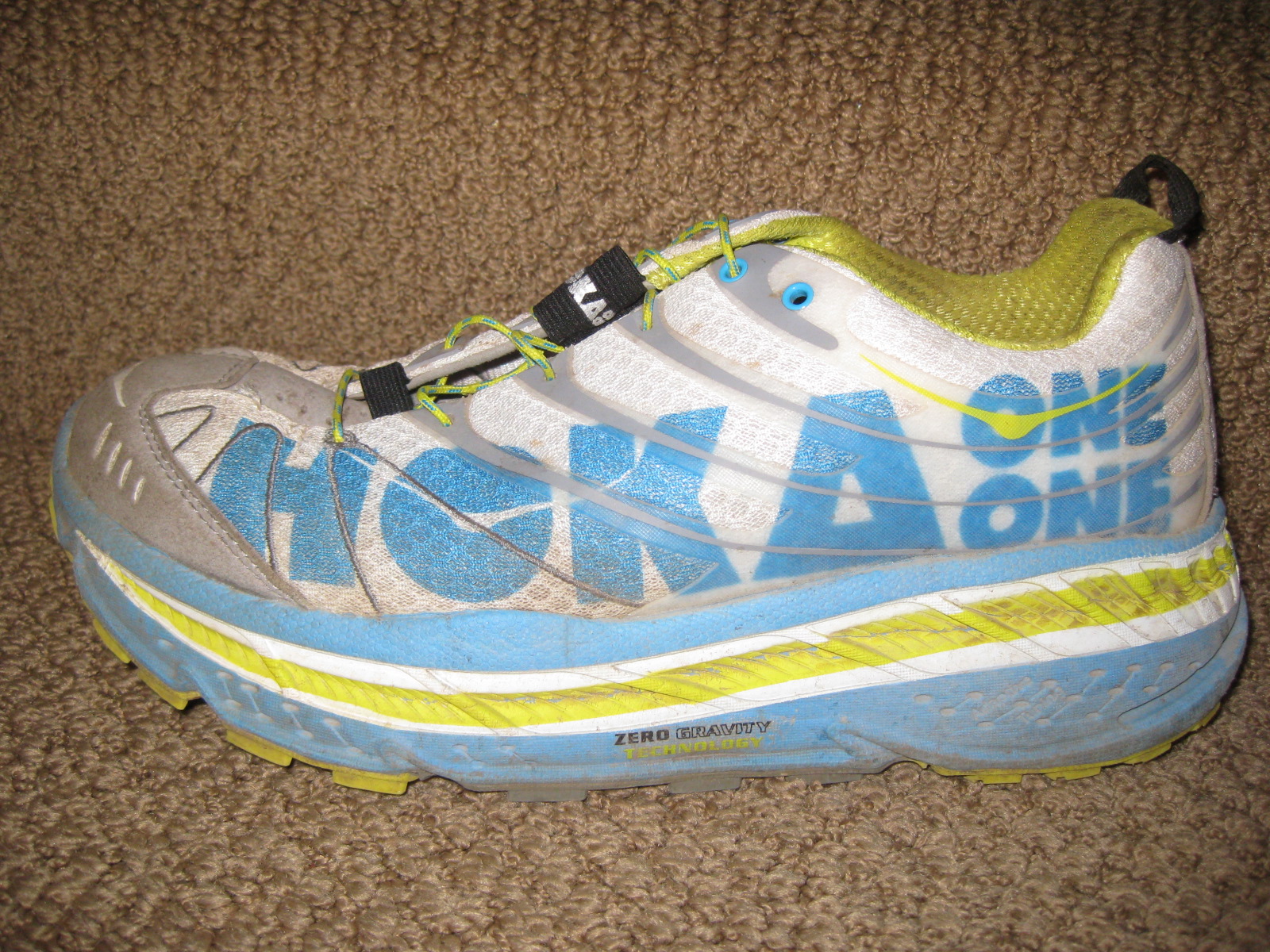
Gear Review - HOKA ONE ONE Stinson EVO B - Moon Boots Rule

Moon Boots Rule

HOKA ONE ONE Stinson Evo B

Running in Hoka shoes is like nothing you've ever experienced!”, were the exact words James the Hoka rep offered up as I cinched down the speed laces on the Stinson EVO B’s. The Hoka One One motto is, It's fun. It's fast. It's freedom. It's flying! Since my first trail ultra I had been searching for a shoe that offered a low heel to toe drop (efficient) while still maintaining a decent amount of cushion (comfort).  As a forefoot striker I naturally gravitate towards minimalist like shoes, my one complaint being that I wanted more cushion.  I know that sounds silly, but after 30+ hilly, rocky, root studded trail miles your feet and body appreciate a little comfort.  Unlike shoes that produce a hard or rigid feeling, Hokas offer up a lot of softness and a sensation of floating.

After one 5 mile run, during which I purposely ran over every rock and root I could find, I was sold.  The shoe not only absorbed the abuse of the trail and hills, but was stable on sharp corners, up hills, and down.  My biggest concern was that with the amount of foam between me and the ground I would no longer feel the trail, rest assured though just as I was unable to feel sharp rocks I could fell every little divot or bump on the path!  This shoe excited me so much that I immediately ordered a pair from Bryon at iRunFar.com, and wore them for a 50 mile trail race.  Yes that’s right, no break in period (experts say not to try something new on race day), just out of the box and onto my feet.  Holy cow did they work, these shoes helped absorb the punishment of the trail so well that I was able to run the final 13 miles in around 1:40, and yes that was after running 37 hilly rocky miles.  This was due to the uniquely designed midsole which softens the increased impacts of downhill running and acts as a buffer against jagged obstacles on the trail.

SHOE SPECIFICS


Here are the specifics of the shoe:
Weight- 10.4 ounces, Men’s size 9
Heel to Toe Drop- 4mm (Thin Insole) 6mm (Thick Insole) yes it comes with both!

In doing a little research I was able to determine the rationale for the Stinson B model.  It was to create a shoe equally at home on the roads as well as trails by combining the best features of its sister shoes, the Bondi and Mafate.  The EVO is suitable for use on all types of on and off road terrain thanks to increased outsole traction while providing responsive cushioning, stability, and efficiency.  I have put my EVO’s to use on the trail, road, and yes the treadmill!  Oversized, light, and stable, the midsole provides a smooth, yet efficient ride. By reducing stress on the body it is an ideal training or racing shoe for ultrarunners, no matter the terrain.

A little more research and I was able to find the new features Hoka enhanced in the EVO which allow it to be used for everyday training yet make it light enough for race day.  First, there is a new light-weight outsole design which has much better traction on all surfaces, thanks to strategically placed high abrasion resistant lugs.  A 50 percent increase in outsole surface area (compared to traditional running shoes) improves grip and stability. The additional surface area allows greater contact with the ground, allowing your foot to dynamically engage the ground while the shoe's outsole gains maximum traction on pavement, dirt trails or rocky surfaces.  Second, the fit and comfort of the upper has been improved particularly with respect to the forefoot area.  Third, efficient, lightweight speed laces are now standard.  Fourth, the midsole has been enhanced with a more contoured sidewall providing slightly more width while still remaining snug.  Fifth, the EVO has been engineered for protection, comfort and propulsion with a rockered geometry that creates a platform for optimally efficient natural running mechanics.  Lab tests have shown that Hokas rockered midsole geometry and low heel-toe differential encourages proper form by allowing a runner to easily strike the ground near the midfoot.   

Like other Hoka One One models, the Stinson B EVO has a low heel to toe angle of 6mm or 4mm, depending on insert (it comes with two), and a rockered forefoot and rear foot. The midsole encourages the wearer to move in a manner similar to the way a barefoot runner does on soft surfaces. This low ramp angle also allows for tremendous confidence running downhill and the oversized midsole is designed to maximize muscle efficiency through the reduction of stress on all muscles and joints, regardless of surface or distance. 

This comes directly from Hoka One One regarding to how the EVO works.  “Recent breakthroughs in materials technology allow for 2.5 to 3 times the usual amount of ultra lightweight resilient foam to be utilized in the patent pending midsole, which is scientifically designed with a midsole geometry engineered to provide far superior biomechanical efficiency, cushioning, responsiveness and performance.  When running or walking, the feather-light EVA midsole compresses to providing excellent shock absorption- it springs back under the forefoot for increased acceleration and propulsion.  Despite the shoes being drastically more cushioned than virtually anything else on the market, because it has approximately 50% more surface area in contact with the ground and a midsole that positions the foot deeply recessed into it, the shoe provides lateral stability and protection on a level similar to many traditional stability running shoes without any midsole posting.”

SIZING

I found the EVO to run true to sizing.  I wear a men’s 9.5 in Montrail and New Balance and this is what I wear in the EVO’s.  The additional set of thinner insoles is provided and can be used to accomplish one of two things; take up volume by adding them on top of the existing insoles, or to add more volume by removing the existing insoles in the shoes and replacing them with the thinner set. The purpose of the extra insoles is to help accommodate people with high volume and narrow feet.

DURABILITY

The 2012 ultra season for me included; 2 50k’s, a 50 miler, a ½ marathon, pacing duties in a 100 miler, and too many long runs to count.  All of these were done in my Hokas and all of them were on rocky, hilly trails.  My EVO’s currently have over 700 miles on them and they are not showing any real sings of wear or breakdown, a solid 1000 miles+ is where I feel these shoes are headed.  The tread on the sole is extremely durable with all of the lugs maintaining their integrity.  I have not had any issues with the material of the shoe, which also happened to be extremely breathable.

In conclusion the Hoka One One Stinson EVO B is a fantastic addition to your running shoe collection.  I believe that this shoe can benefit every runner.  If you like comfort, it has it.  Also if you normally run more minimal this shoe can work great for recovery runs.  I would highly recommend this shoe regardless of terrain or distance. (Well maybe not a 5k, but I have done speed work in mine!)  The shoe is a bit pricey ($170) compared to some, but with its durability the cost per mile of the shoe makes it relatively cheap.  I will continue to run in Hokas!  I am currently looking over my early 2013 schedule with a road 50K as my A race, so I may need to grab a pair of the new Bondi B 2.

P.S. As a great side note, Hokas are an amazing winter running shoe.  The EVO’s tread allows for amazing traction on snow.  An unforeseen, but awesome, benefit due to the greater volume of cushion in the Hokas is that the sole does not freeze in extreme cold weather.  Yes I know this sounds weird but for those of us from more northern latitudes when you run long on really cold days your sole can actually freeze, making it feel like you are running on an ice cube, causing your feet to freeze!

05 March 2013

2013 February Training and Race Nutrition Planning

February Training and Race Nutrition Planning


This was a packed strength building month; I managed to up both my mileage and intensity.  I also managed to shovel a ton of snow, great cross training, right.  I swapped out my Monday tempo runs for hill repeats but stuck to the rest of my previous schedule of hill, easy, tempo, easy, race pace, long, off.  I was able to climb almost 7000ft over 10 miles (15%ish) when you add up the repeats that I completed, not bad for flat land WI. 

This month I also wanted to race a ½ marathon, there were not any that fit my schedule, so I decided to run one on my own.  There were two reasons I wanted to race; first was to benchmark my training, and second I wanted to be able to test out my race nutrition strategy. 

Of all of the race efforts I have laid down, from 100m to 50 miles, this was the most mentally taxing.  Racing yourself and having to maintain pace is mentally exhausting, several times I had to fight off demons begging me to just sit down in a snow bank and rest.  Another reason this effort was tough was that I had to dig my house out a heavy snowfall as a warm up.  Never before has my upper back cramped during a race, so going forward I will not be utilizing snow shoveling as a pre-race warm up.  The race effort ended up being good I finished in 1:21:32, with the final 10k being run at 6:00 pace.

The reason that I wanted to focus on my race nutrition was that I have been running all of my long runs on minimal calories and my tempo and hill runs on no calories.  As I have written before I follow a higher fat, moderate protein, low carb diet.  In an effort to keep my body burning fat during exercise, I have begun all of my workouts in a fasted state.  This means the last time I ate food was 10+ hours before the workout, I will have green tea with coconut oil before some of the more intense sessions with a VESPA before the longer sessions.  I wanted to see; first how my stomach would tolerate my planned nutrition strategy at sub race pace, and second what my energy would be throughout the run.  I am happy to report that my plan seems to be a success, I not only tolerated the drinks and gel combo, but my energy both mental and physical was stable throughout the race.  What follows is a description of how I ate the day before my race, morning of the race, during the effort, and after.  Keep in mind this is not all I ever eat and the post-race dinner meal happened to be a sushi date.

Day Before

AM: 12oz warm water with apple cider vinegar, green tea with coconut oil, 1 multi vitamin, 1 fish oil, 1 vit D3

Easy 5mi run with 5 pickups at 5:00 pace.

Full fat Greek yogurt with cinnamon, flax, 1/4C blueberries, 1/4C pineapple, ½ banana
1 multi vitamin

Snack ¼ C raw almonds

PM:  Large kale salad with avacado, beets, broccoli, asparagus, chicken, ½ sweet potato, walnuts, and shredded mozzarella cheese

Foam rolling, active isolated stretching, & 1 magnesium

Race Day

Pre-Race:  12oz warm water with apple cider vinegar, green tea with coconut oil, 1 multi vitamin, 1 fish oil, 1 vit D3
1 Packet of Justin’s Chocolate Hazelnut Butter (3 hours pre-race)
1 VESPA JR (45 min prior to race)

Race: 1 20oz bottle with chocolate coconut water & 3 gels.

Post-race: Coconut water, ½ grapefruit, ½ sweet potato, and full fat Greek yogurt with cinnamon, flax, 1/4C blueberries, 1/4C pineapple, ½ banana
1 multi vitamin

Snack: ¼ C raw almonds

PM:  12 piece sashimi, seaweed salad, miso soup, edema me, 1 glass red wine, 1/2C almonds & walnuts mix, Kale Chips

Foam rolling, active isolated stretching, & 1 magnesium

Going forward I am going to stick with the chocolate nut butter for breakfast pre-race, I believe it provides me with adequate calories, fat, and carbohydrates, without spiking my blood sugar too much pre-race.  It is also extremely convenient and travels well!  In a pinch I could use Nutella, although the sugar content is higher.  I will increase the amount I consume based on the distance of the race.  Another pre-race food I have used is ½ sweet potatoes with raw almond butter on top.   

TOTALS

RUN               197.1 Miles  27:22:42
BIKE              6.5     Miles
SWIM            5.6     Miles

Elevation Gain (Hill Repeats)
6600ft 10mi (15%)

Race
Me VS Myself ½ Marathon
1:21:32 (6:14) pace last 10k at 6:00